Thursday, February 7, 2013

Celebrating One Month of Homemade-Food Businesses in California - Jennifer Huerta


This week, we're celebrating one-month of homemade foods by profiling cottage-food producers from throughout California.  While many people think of trendy neighborhoods like San Francisco's Mission or Los Angeles' Silver Lake as the only places where cottage food industries thrive, as I have looked around the state I have found homemade food business almost everywhere. 

Today I'm profiling a cottage food entrepreneur from California's great breadbasket, the central valley city of Visalia, and home-jelly artisan Jennifer Huerta.  The article below is an excerpt from a larger article on Ms. Huerta and AB 1616 that appeared in the Visalia Times-Delta.  I wish her all the best as she continues producing delicious home-made jams and jellies.



Tulare County 'cottage' food businesses appreciate new state law

After months without a job and dried up unemployment benefits, Jennifer Huerta was looking forward to the start of the new year, and with it, the start of a new law for “cottage” food businesses.

Huerta, a Visalia mother of four, said she heard about the California Homemade Food Act last year, before Gov. Jerry Brown in September signed it into law...


...Huerta can’t afford to lease a kitchen or to pay for somebody to watch her three youngest children while she’s out making jellies, so the new law will allow her to earn some income by starting a home-based — or “cottage” — business, Jams by Jen.

“I can be home with my children, making a living,” said Huerta, who lost her job as a finance officer after her family’s staffing business shut down in September 2011 because of the poor economy. Huerta couldn’t find another job and while she’s been out of work she learned how to cook jams and jellies, inspiring her idea to start a home-based business.

“I’m just really excited to go out into the community to sell something different and homemade,” said Huerta, who has 60 jars of jelly neatly stacked on shelves in her home office. She can’t sell them yet.

She hopes that will change after Tuesday, when the Tulare County Board of Supervisors is expected to approve the registration and permit fees that would allow Huerta and others to start their cottage food businesses here.

Before the new law — California Assembly Bill 1616 — took effect Jan. 1, food prepared in private homes couldn’t be offered for sale or used in food businesses, including restaurants. The new law “requires a cottage food operation to meet specified requirements relating to training, sanitation, preparation and permissible types of sales,” according to the report...


...“Providing people with the opportunity to make and sell these foods directly to their neighbors at the local farmer’s market or through the specialty shop up around the corner is a matter of access to opportunity,” stated California Assemblyman Mike Gatto, D-Los Angeles, who wrote the bill, in a news report after California’s governor signed it into law in September.

It goes on to say the bill should promote neighborhood commerce and help “micro-entrepreneurs” start businesses.

“Now, cottage food producers will be permitted to produce and sell every-day foods such as breads, tortillas, dry roasted nuts and legumes, cookies, granola, churros, jams, jellies and other fruit preserves to their communities,” Gatto’s statement continues...

...The state isn’t paying for the counties to register and oversee cottage food businesses, so each can set its own fees based on the projected costs. In Tulare County’s case, the supervisors will consider on Tuesday whether to set the Class A registration fee at $175 a year and the Class B fee at $291 a year.


“Wow, that’s high,” said Huerta, adding that she has been in touch through Facebook with other people looking to start cottage food businesses in other parts of the state, and they have heard of Class A registration fees being as low $62...

...Despite the cost, Huerta said she plans to register as a Class A cottage business, because she plans to sell her jams and jellies on her own and get customers by word of mouth...

# # #

You can read this entire article and more at the Visalia Times-Delta HERE

Mike Gatto is the Chairman of the Appropriations Committee of the California State Assembly.  He represents the cities of Burbank, Glendale, La Canada-Flintridge, La Crescenta, Montrose, the Los Angeles neighborhoods of Los Feliz, Silver Lake, Atwater Village, and portions of the Hollywood Hills and East Hollywood.   www.asm.ca.gov/gatto


Wednesday, February 6, 2013

Gatto introduces bill to protect businesses from 'shakedown' lawsuits

Assembly Bill 227 would give businesses 14 days to fix Proposition 65 violations, protecting them from so-called "shakedown" lawsuits, proponents say. Above, Le Comptoir in Glendale. (Tim Berger/Staff photographer / February 6, 2013)

Assemblyman Mike Gatto (D-Silver Lake) introduced a bill Monday to protect businesses from “shakedown” lawsuits that are filed with the intent of extracting settlements to make the litigation go away.
Business owners told Gatto at his Small Business Advisory Commission’s meeting last month that Proposition 65 – which allows the public to sue businesses for up to $2,500 for each day signs aren’t posted about the dangers of chemicals known to cause cancer or birth defects -- is easily abused by lawyers who file claims with the sole purpose of extracting settlements...
...Gatto’s bill, AB 227, would allow a business owner who receives notice of a Prop. 65 violation to avoid retrospective fines by fixing the violation within 14 days, according to a statement released on Tuesday.
“The voters passed Prop. 65 to be protected from chemicals that would hurt them,” Gatto said in his statement. “They did not intend to create a situation where shakedowns of California’s small-business owners would cause them to want to close their doors.”
-- Daniel Siegal, Times Community News
Follow Daniel Siegal on Google+ and on Twitter: @Daniel_Siegal

You can read this entire article and more at the Glendale News Press HERE

Mike Gatto is the Chairman of the Appropriations Committee of the California State Assembly.  He represents the cities of Burbank, Glendale, La Canada-Flintridge, La Crescenta, Montrose, the Los Angeles neighborhoods of Los Feliz, Silver Lake, Atwater Village, and portions of the Hollywood Hills and East Hollywood.   www.asm.ca.gov/gatto

Celebrating One Month of Homemade-Food Businesses in California - Melissa Bain

This week, we're celebrating one-month of homemade foods by profiling cottage-food producers from throughout California.  While many people think of trendy neighborhoods like San Francisco's Mission or Los Angeles' Silver Lake as the only places where cottage food industries thrive, as I have looked around the state I have found homemade food business almost everywhere.

Yesterday we traveled to the border to visit Riverside County's Patty White and Leah Delyte DiBernardo.  Today, I'm going back up to NorCal, Marin County to be specific, and profiling Larkspur resident Melissa Bain.  A former database programmer, Ms. Bain recently became the first resident of Marin County to obtain a cottage food license, for her business "Blissful Treats."  The article below is an excerpt from a larger article on Ms. Bain and AB 1616 that appeared in the Marin Independent Journal.  I wish her all the best as she continues producing what appear to be delicious cookies and baked goods.


Larkspur woman opens first permitted residential kitchen in Marin

Whipping up batches of cookies and cupcakes is more than a hobby for Larkspur resident Melissa Bain. Her apartment kitchen was recently dubbed the first permitted residential kitchen in Marin, thanks to a new state law that took effect Jan. 1.


Within the past two weeks, Bain has set up shop in her kitchen with the intent to bake treats for the wholesale and retail markets. Selling her goods would've been illegal prior to the passage of Assembly Bill 1616, which allows Californians to make and sell certain foods from their kitchens.

Bill supporters say it will allow people who don't have access to a commercial kitchen or can't afford one to sell their home-baked goods.

Bain, 39, said she had learned about the new law in December after deciding that her work as a database programmer wasn't enough to keep her busy. She made some confections for her friends and asked them whether she should go into business.

"I got so much positive feedback from it," Bain said.

After procuring a business license for "Blissful Treats," taking an online food handlers' course and having her kitchen looked at by a county health inspector, Bain is ready to make her favorite salted caramel chocolate cupcakes for widespread consumption.

She said she was surprised to learn she's the first one in the county to get one of the permits.

"I truly thought other people would be jumping on the bandwagon," Bain said.

She said the process has been fairly straightforward, but involved filling out a large packet of paperwork for the county's environmental health services department. This included determining how much each product costs to make and what to sell it for.

"It's a perfect exercise for individuals to figure out if they really want to do it," Bain said.

Bain is focusing on cupcake flavors like white chocolate coconut and carrot cake. Some of her favorite cookie flavors include ginger molasses, rose water cardamom, chocolate peanut butter and oatmeal raisin.

"I try to keep things a little bit on the simple side," Bain said.

Dave Smail, supervising registered environmental health specialist, said Marin officials have been busy reviewing the new law and developing guidelines. He said it will be interesting to see how many people are waiting in the wings to get a permit and start their own businesses.

"The goal of this law was to bolster micro-economies," Smail said...

...Bain said she'll be happy when she makes her first official sale.

In the meantime, she's been busy baking cookie donations for WildCare, a wildlife rehabilitation center in San Rafael, where she volunteers once a week.

 "I'm trying to keep myself entertained," Bain said.

If all goes as planned, Bain will soon have a long list of clients and her own booths at multiple farmer's markets. She said baking gives her a chance to exercise different skills than those used in her information technology job.

"I wanted to tap into the creative energies a bit," Bain said.

# # #

You can read this entire article and more at the Marin Independent Journal HERE

Mike Gatto is the Chairman of the Appropriations Committee of the California State Assembly.  He represents the cities of Burbank, Glendale, La Canada-Flintridge, La Crescenta, Montrose, the Los Angeles neighborhoods of Los Feliz, Silver Lake, Atwater Village, and portions of the Hollywood Hills and East Hollywood.   www.asm.ca.gov/gatto

Tuesday, February 5, 2013

Celebs now fashionable targets in hoax 911 calls

I've introduced legislation to address the growing problem of "swatting" in California.  The article below shows highlights from a larger article that discusses this challenge and the solutions being proposed to address it.

Justin Bieber attends the 3rd annual Tribeca Disruptive Innovation Awards during the 2012 Tribeca Film Festival at NYU Paulson Auditorium in New York April 27, 2012. — Reuters Photo

LOS ANGELES: Celebrities have long contended with the occasional downsides of stardom — tabloid scandals, stalkers, box office bombs, the paparazzi. Now, add “swatting” to the list — a prank that sends police charging to the gates of stars’ homes on false reports of gunmen, hostages or other crimes in progress.

Instead of bad guys, responding officers, police dogs, helicopters and sometimes SWAT teams have found only stunned domestic and security staff unaware of any trouble — because there wasn’t any.

The recent hoax 911 calls to the homes of Tom Cruise, Justin Bieber, Ashton Kutcher, Chris Brown and other stars are leading authorities to eye some 911 calls with extra suspicion and lawmakers to call for stiffer penalties for the pranksters...

...Los Angeles police Cmdr. Andrew Smith said the department has seen an increase in the number of swatting calls since last year, when stars such as Kutcher, Bieber and Cyrus were targeted.


“People are jumping on the bandwagon thinking it’s funny or a clever or interesting,” Smith said. The calls aren’t just tying up patrol officers, but also investigators probing the pranks who could be assigned to larger crimes.

“The last thing we want to have our detectives do is spend a bunch of time on a foolish prank like this,” he said. “We want our detective handling robberies, burglaries and other crimes...”


...The California bill, which is also being proposed by Assemblyman Mike Gatto, would increase the penalties for convicted swatters to up to three years in jail if someone was hurt as a result of their call, and also make them responsible for the costs of the emergency response...

You can read this article and more at Dawn.com by click HERE


Mike Gatto is the Chairman of the Appropriations Committee of the California State Assembly.  He represents the cities of Burbank, Glendale, La Canada-Flintridge, La Crescenta, Montrose, the Los Angeles neighborhoods of Los Feliz, Silver Lake, Atwater Village, and portions of the Hollywood Hills and East Hollywood.  www.asm.ca.gov/gatto

# # #


PRESS RELEASE: Small Business Advisory Commission Generates Legislation to Help Small Businesses Avoid Shakedown Lawsuits


FOR IMMEDIATE RELEASE                                      Contact: Justin Hager: (818) 558-3043
February 5, 2013                                                                                 Cell: (415) 889-9762

Assemblyman Gatto’s Business Advisory Commission
Generates Legislation to Help Small Businesses Avoid Shakedown Lawsuits

SACRAMENTO – On Saturday, February 2, members of Assemblyman Mike Gatto's (D-Los Angeles) Small Business Advisory Commission voted to ask him to introduce legislation to address a new breed of shakedown lawsuits plaguing small businesses in Southern California.  On Monday, February 4, Assemblyman Gatto did what the Commission asked, introducing legislation that allows a business owner who receives notice of a Proposition 65 violation to remedy a violation, and achieve compliance within 14 days, without facing exorbitant retrospective fines.  

Prop. 65, the Safe Drinking Water and Toxic Enforcement Act, was passed by voters in 1986 and provides that a business in California may not expose individuals to chemicals known to cause cancer and/or reproductive toxicity without first giving clear and reasonable warning.  The State of California publishes a list of more than 800 chemicals known to cause cancer, reproductive harm, or birth defects.  Originally intended for serious exposures or failures to warn, Prop. 65 lawsuits have recently been abused by unethical attorneys.  A coffee shop owner in Gatto's district was sued for hundreds of thousands of dollars for failing to notify his customers that beer could cause cancer.

Such suits exist because the law allows for fines of $2,500 per day, enforced by any plaintiff.  Most people suing businesses expect that a small business, wary of litigation costs, will opt for a quick settlement to make the lawsuit go away. 

As introduced, AB 227 would further the original intent of Prop. 65, which was obtaining compliance with warnings for chemicals present on a site.  It would therefore allow a business that receives a notice of a private action to correct the violation, i.e., post the Prop. 65 warning, within fourteen days without being subject to the retroactive $2,500 per day fine. 

“The voters passed Prop. 65 to be protected from chemicals that would hurt them.  They did not intend to create a situation where shakedowns of California’s small-business owners would cause them to want to close their doors,” said Gatto.   

Assemblyman Gatto formed the Small Business Advisory Commission this year to advise him on challenges facing local small-business owners.  The eight member commission discussed a variety of concerns impacting small businesses and voted unanimously for Gatto to introduce the bill to reform Prop. 65 so that the law’s intent is not undermined.
 
“I had the opportunity to listen to concerns of local business owners on the Small Business Advisory Commission.  The severe negative impact of shakedown lawsuits under Prop. 65 was immediately apparent,” said Gatto.  “Most business owners work hard to protect customers so that the customers return.  This is especially true with small-business owners whose customers are neighbors, friends, and relatives.  This common-sense bill will help small businesses avoid costly litigation while ensuring that the public has the proper warnings about potentially dangerous chemicals.”


Mike Gatto is the Chairman of the Appropriations Committee of the California State Assembly.  He represents the cities of Burbank, Glendale, La Canada-Flintridge, La Crescenta, Montrose, the Los Angeles neighborhoods of Los Feliz, Silver Lake, Atwater Village, and portions of the Hollywood Hills and East Hollywood.  www.asm.ca.gov/gatto

# # #

Monday, February 4, 2013

Celebrating Homemade-Food Businesses - Patty White and Leah Delyte DiBernardo


This week, we're celebrating one-month of homemade foods by profiling cottage-food producers from throughout California.  Yesterday we saw a cottage-food business in the Northern California town of Oroville.  Today I'm looking to the opposite end of the state, to Riverside County's Patty White and Leah Delyte DiBernardo.  The article below is an excerpt from a larger article on AB 1616 that appeared in the San Diego Union Tribune.  I wish Patty White and Leah Delyte DiBernardo  the best as they continue producing healthy homemade food options for our communities.


State opens way to sell food from home kitchens
By David Downey - Jan. 25, 2013

Temecula resident Patty White makes her chocolate-covered peanut clusters at home and sells them at area farmers markets. She was one of the first people to obtain a permit from Riverside County to sell goods baked in a home kitchen. — Don Boomer
For years, Patty White has been making delicious treats for holiday gatherings.

“I make chocolate peanut clusters," White said. "And the recipe is my great-grandmother’s. Everybody loves it and asks me how I make it, and I’m not going to tell them.”

After losing a managerial job in cellphone sales last year, the Temecula woman in her 50s is making the sweet and crunchy desserts for more than family. For the last couple of weeks, she has been selling half-pound bags of clusters at area farmers markets.

White said she has had difficulty finding another job despite a long career in sales. And the state's new cottage food law gave her an opportunity to earn income doing something she enjoys.
Assembly Bill 1616, or the California Homemade Food Act, took effect Jan. 1. The law opened the door for entrepreneurial-minded Californians such as White to sell a limited range of food products made in home kitchens...

...A lot more will be sought once people get wind of the program, said Leah Delyte DiBernardo, co-owner of E.A.T. or Extraordinary Artisan Table in Temecula.

E.A.T. is both a catering business and seller of locally produced food. And DiBernardo said she sent a letter to Gov. Jerry Brown last year urging that he sign Gatto's bill.

Until now, local food producers have had to rent certified kitchens and obtain insurance in order to sell homemade food, DiBernardo said.

"We’ve been renting our kitchen the past few years to people who are doing this," she said. "We did it at a lower cost to support these people, because renting a kitchen can cost anywhere from about $25 to $70 an hour.”

By authorizing production on home stoves, the law is saving people thousands of dollars, she said.

"I think that it’s really important because we have taken such a huge step back from supporting local artisans," DiBernardo said. "This is actually something people have been fighting for, for more than a decade.”

Since the first of the year, 15 to 20 calls a week have been pouring in from people interested in selling homemade food, said Gale Cunningham, market administrator for Farmers Market Management Company Inc.

Cunningham's firm sponsors four farmers markets: one in Murrieta, one in Corona and two in Temecula.

At the moment, she said, every selling slot is spoken for.

As for White, the former cellphone saleswoman, she was one of the first to obtain a permit from Riverside County -- for selling those chocolate-covered peanut clusters.

White said she sold half-pound bags for $6 the last two weekends at farmers markets in Menifee, Canyon Lake and Corona.

“The response has been just great,” she said.

White said the treats come in three varieties of chocolate: milk, white and dark.

As for the original cluster crafted by her great-grandmother, it came with milk chocolate, White said. But she said that's as far as she will go, in revealing the top-secret recipe.

You can read this article and more at the San Diego Union Tribune HERE

Mike Gatto is the Chairman of the Appropriations Committee of the California State Assembly.  He represents the cities of Burbank, Glendale, La Canada-Flintridge, La Crescenta, Montrose, the Los Angeles neighborhoods of Los Feliz, Silver Lake, Atwater Village, and portions of the Hollywood Hills and East Hollywood.   www.asm.ca.gov/gatto

Celebrating One Month of Homemade-Food Businesses in California - The Chaffin Family


This week, we're celebrating one-month of homemade foods by profiling cottage-food producers from throughout California.  Today we're profiling the Chaffin Family, small-business owners in Oroville, CA and recent recipients of a license to sell food produced in a home kitchen.  The article below is an excerpt from a larger article on AB 1616 that appeared in the Chico News and Review.  I wish the Chaffin's the best as they continue producing healthy homemade food options for our communities.


Chico News and Review - Jan. 31, 2013 
By Christine G.K. LaPado-Breglia 

“...The primary thing that AB 1616 offers us is … being able to do things with dried fruit, you know, like chocolate-dipped, for gift packs and things of that nature,” said Chris Kerston, managing partner at Oroville’s Chaffin Family Orchards (go to www.chaffinfamilyorchards.com to learn more), in a recent telephone interview.
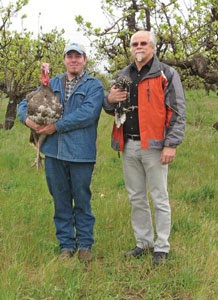
Chaffin Family Orchards' Chris Kerston (Left) and Butte County Public Health Environmental  Health
Director Brad Banner, shown here at the Chaffin farm, are please with Assemblyman Gatto's new bill - AB 1616.
Photo by Claire Hitkins Seda / Chico News and Review
Chicoans are familiar with Chaffin Family Orchards’ permaculture-raised fresh fruits and vegetables (and, of course, its dried fruit), grass-fed meats and award-winning olive oils, often via its booth at the Saturday farmers’ market in downtown Chico. “Until AB 1616, we were allowed to sun-dry the fruit, but you weren’t allowed to ‘value-add’ it in any way,” said Kerston. “We would have had to rent a commercial kitchen,” which can be pricey, he noted.

Ditto for making jam, which Chaffin Family Orchards produced before the passage of the California Homemade Food Act. “We’ve always had to rent a commercial kitchen for jam,” Kerston said. “If you go to a commercial kitchen, you’re renting for a particular date, once a month. You can’t save the culled fruit [for this purpose]—you have to take first-run fruit. If you’re making small batches of jam in a [home] kitchen, you can use culled fruit as the ‘waste’ fruit presents itself.”

Kerston brought up the example of peaches... which
before AB 1616 "often would end up as
livestock feed" simply because of appearance.
Kerston brought up the example of peaches: “Say you have a peach that is 90 percent good, or has a bug bite, or a bird strike. You can’t sell that at the farmers’ market as whole fruit as customers are generally turned off. Now, we have a ‘home’ for our ‘seconds,’” which before AB 1616 “often would end up as livestock feed” simply because of the appearance.

“Now, we can do a small batch of jam every weekend after the farmers’ market, rather than a once-a-month date,” Kerston said. “We’re looking forward to taking advantage of this in summer.”

But even more important than the fact that the California Homemade Food Act allows small businesses to use home kitchens for food preparation, notes Kerston, is the fact that the new law increases access to healthful food.

As Kerston explained it, “The [food] movement right now is trying to go back to this old-fashioned, heirloom way of life, but the reality is, in our modern society, everyone’s really busy. Sixty years ago, every home had one person in the household whose sole job was to feed and clothe the family—and we don’t have that anymore. And that’s OK.

“But for this food movement to grow, and for people to have access to fresh, healthy food, we have to be able to offer them ready-to-eat foods. The more we can remove the barriers [to accessing fresh, healthful, ready-to-eat foods], the more people will have access to healthy foods.

“This is designed to be an incubator program,” Kerston added, of AB 1616. “It allows small businesses to see what works before renting a full-blown commercial kitchen and getting a staff and all those next steps of growth. It provides an opportunity to get some experience, some customer feedback before taking those next steps on growing your business.”

You can read this entire article and more at the Chico News and Review HERE

Mike Gatto is the Chairman of the Appropriations Committee of the California State Assembly.  He represents the cities of Burbank, Glendale, La Canada-Flintridge, La Crescenta, Montrose, the Los Angeles neighborhoods of Los Feliz, Silver Lake, Atwater Village, and portions of the Hollywood Hills and East Hollywood.   www.asm.ca.gov/gatto